
Home > Implementation for Educators Blog
What is Facilitative Administration? Why does it matter in implementation?

Educational agencies across the country are implementing practices and programs in their efforts to improve student outcomes. However, the question remains: why are so many unsuccessful in their efforts? The answer is that they lack the structures and systems needed to fully implement or sustain practices (Fixsen et al., 2005; Fixsen & Blasé, 2008). The Implementation Drivers within NIRN’s Active Implementation Formula support educational agencies in creating the infrastructure and support needed for successful implementation.
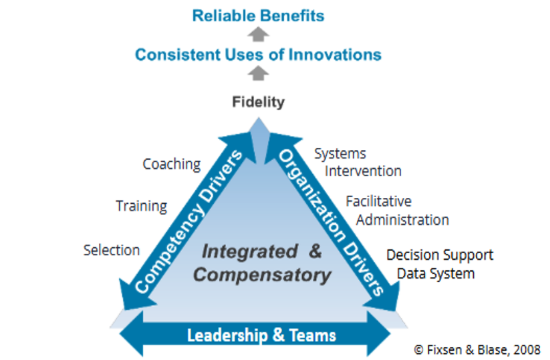
The competency drivers support the development of skills that enable practitioners to implement a practice to fidelity, while the organizational drivers address the structures, processes, and resources needed within the system to support practitioners’ effective use of the practice. This blog will take a deeper dive into one of the organizational drivers, facilitative administration, examining what it is and how it impacts implementation.
Facilitative Administration – What is it?
Before we examine facilitative administration as a driver, let’s first look at its name – what does facilitative administration actually mean? Asking Google (n.d.) for a simple definition, facilitative means “something that makes an action, activity, or result easier,” simple enough. Doing the same for administration, it is a little more complex, referring to the “process of managing and organizing the activities, resources, and responsibilities within an organization or system” to effectively achieve goals, elaborating that this could include many different activities. Putting these together fits the overall function of facilitative administration as an implementation driver – leaders and teams being intentionally focused to create organizational conditions needed for effective implementation. This includes aligning, developing, and adapting internal processes, policies, systems, and structures needed to support the implementation of a practice or program (Fixsen et al, 2009; Ward et al., 2018). Let’s first look at a couple of key implementation activities that support the work within facilitative administration.
Creating a Hospitable Environment
The overall function of the Implementation Drivers is to create a hospitable environment for implementation, creating organizational and system-level conditions that make it possible to adopt, implement, and sustain a practice over time. With facilitative administration, the focus is not only on the practice, but more significantly the larger context and how it impacts implementation. Building a hospitable implementation environment requires developing supportive conditions that enable practitioners to implement the practice as designed. Creating this type of environment requires engaged leadership and teams, including those who have the authority to make system-level decisions, to develop the conditions for successful implementation.
Creating a hospitable environment requires attention to the organization’s climate and culture. Practitioners need to feel safe and supported in trying out new practices (Metz et al, 2022) in an environment where organizationally, implementation is viewed as an opportunity to learn, adapt, and get better. Communication systems play a critical role in facilitating this, relying on a linked teaming structure with bi-directional feedback loops. This linked system ensures information, guidance, and support flow across all levels of the organization to practitioners, with practitioners’ experiences, insights, and feedback elevated to inform decision-making, continuous improvements, and system-level change.
To effectively implement systems change, new processes and structures need to be established. To support this work, leaders and teams need to review existing policies and procedures to evaluate where there is alignment, identify policies and procedures that can serve as facilitators, and identify any that may act as a barrier. A core element within facilitative administration is problem-solving to address barriers across the system. Developing a systematic process for problem-solving supports readiness, collaboration, and trust within the work (Metz et al, 2024). This is not a one-and-done process. Regular reviews should become routine practice to identify where adjustments need to be made to ensure a practice can effectively be supported and sustained over time.
Building the Infrastructure
Implementing a new practice also requires changes in how individuals operate within the system, requiring changes in processes, procedures, and adult practices. Engaged leaders, working within a link teaming structure make this happen by developing and refining organizational systems, structures, and supports needed for implementation. One system, as noted above, is a communication system. An effective communication system links implementation teams within an agency, as well as across levels within the educational structure, such as creating a coordinated system that links state and regional agencies with districts and schools. Let’s examine a few more structures that are developed through facilitative administration.
Implementing a new practice requires new learning and changes in existing practices to achieve intended outcomes. To support learning and practice changes, professional learning systems need to be developed. Professional learning systems should be developed to accommodate diverse adult learning needs related to implementation and new practices, tailored to provide support based on distinct roles, responsibilities, and context within different levels of the system. For example, coaches within a regional agency may need training and coaching to support districts and schools in establishing structures as well as training specific to the practice, while a teacher in the classroom may need more intensive training related to the practice with coaching to support its application within the classroom. At each level, effectiveness and fidelity measures need to be collected and analyzed to inform adaptations or additional structures and supports needed within the systems for improved and sustained implementation of the practice.
This speaks to another foundational system needed for effective implementation, a robust data system. While a decision support data system (DSDS) itself serves as an organizational driver, it is through facilitative administration that its full function and value are realized. Implementation at any stage relies on data-driven decision making, requiring a dynamic data system that has the capacity to integrate various forms of data to inform implementation. Implementation teams need comprehensive and timely data throughout implementation to monitor systems, support practitioner practice, and evaluate population outcomes. An effective data system requires attention to the structures needed to collect and use data at each level and to share data across the system. The application of data in decision making helps teams determine the implementation activities, supports, and adjustments needed to continue to move implementation forward.
Impact on Implementation
The Implementation Drivers are integrated and compensatory in nature. The integrated nature of facilitative administration as a driver is evident in that it supports creating conditions that allow the other drivers to function effectively. Leadership and teams attend to policies, procedures, and structures needed to develop the competency drivers in creating selection criteria for districts, schools, and practitioners, and in building systems for professional learning. Accomplishing this requires interaction with the other organizational drivers, such as engaging with the data system to inform and refine system supports needed to develop adult practices. Leaders and teams interact and gain feedback from critical perspectives, such as boards and curriculum providers, to inform the design and structure of these supports.
As to the compensatory nature of facilitative administration as a driver, it can support other drivers as they are being developed, focusing on the procedures or structures needed to implement the practice to fidelity within the system. For example, in creating a system for professional learning, training structures can be designed to include measures that capture outcome data. Leaders and teams can then use this data to develop their coaching system.
To effectively implement a practice or program, it requires having a usable practice that is implemented effectively within an enabling context, as demonstrated through NIRN’s Active Implementation Formula. Being a multiplication formula, each component interacts and influences each other. The extent to which each component is in place impacts how well outcomes are achieved.
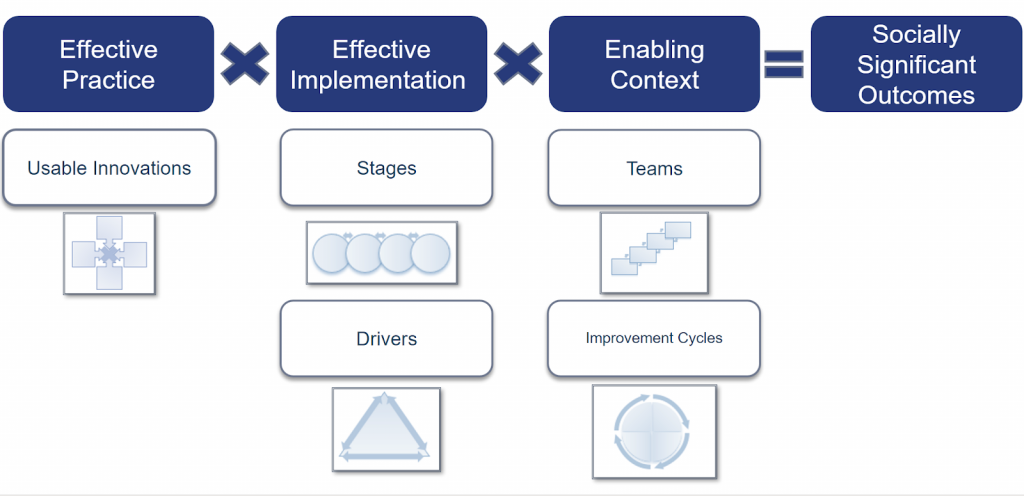
As a driver, facilitative administration also influences the functions of all the other implementation frameworks. Let’s look at how it does so.
- Usable Innovations: Teams examine organizational policies, practices, and needs to determine if a practice is a strong fit and is feasible to implement, then build the structure and supports needed to implement the practice to fidelity.
- Stages: Teams work to embed the practice into organizational structures to ensure systems, structures, and resources support movement through the stages, from assessing readiness and building infrastructure to implementing and continuously improving for sustained implementation.
- Teams: Teams within a linked team structure are connected through communication and data systems that are intentionally developed and continually revisited to support ongoing needs within the system.
- Improvement Cycles: Teams continuously use data to assess the current state of implementation, identify successes and barriers, and make informed adjustments to strengthen implementation across the system.
Wrap Up
Facilitative administration plays a key role as an organizational driver in ensuring that systems, structures, and leadership decisions actively support implementation. Without careful attention, any one of these can serve as a hinderance to implementation. Facilitative administration, at its core, is about responsiveness and problem-solving at a systems level. Leaders engage with implementation teams in decision-making to ensure policies and procedures align, systems are developed, resources are allocated, and data is used for continuous improvement – all needed to create conditions that allow practitioners to implement a practice with fidelity to reach intended outcomes.
Additional Resource
References
Fixsen, D. L., & Blase, K. A. (2008). Drivers framework. Chapel Hill, NC: University of North Carolina, National Implementation Research Network, Frank Porter Graham Child Development Institute.
Fixsen, D., Naoom, S., Blase, K., Friedman, R., Wallace, F. (2005). Implementation research: A synthesis of the literature. Tampa, FL: University of South Florida, Louis de la Parte Florida Mental Health Institute, National Implementation Research Network. Institute of Medicine (IOM). 2007. The Learning Healthcare System: Workshop Summary. Washington, DC: The National Academies Press.
Google. (n.d.). Google. https://www.google.com/
Metz, A., Jensen, T. M., Dicharry, L., & Farley, A. B. (2024). Building trusting relationships in teams to support evidence use and implementation in human services: Feasibility and acceptability of a training and coaching approach. Frontiers in Health Services, 4, 1353741. https://doi.org/10.3389/frhs.2024.1353741
Metz, A., Jensen, T. M., Farley, A., Boaz, A., Bartley, L., & Villodas, M. (2022). Building trusting relationships to support implementation: A proposed theoretical model. Frontiers in Health Services, 2, 894599. https://doi.org/10.3389/frhs.2022.894599