
Home > Implementation for Educators Blog
Where Learning Comes Together: Combining a Community of Practice and a Micro-credentialing Program
If you have ever been in a training and thought, “This is helpful…but how do I actually use this in my day-to-day work?” you are not alone. What if learning did not stop at understanding, but led to action? How do we move implementation support practitioners beyond understanding, to support them in building and applying implementation science knowledge in real-world practice? That gap between learning something and applying it is real, and it’s exactly where a Community of Practice comes in.
What is a Community of Practice?
A Community of Practice (CoP) is a collaborative space where people come together to learn, apply, and improve how work happens in real settings. But in the case of SISEP’s micro-credentialing program CoP, it’s not just about discussion; it’s about turning learning into action through micro-credentialing. “Communities of practice are groups of people who share a concern or a passion for something they do and learn how to do it better as they interact regularly” (Wenger-Trayner, E. & Wenger-Trayner, B., 2015). Guided by the SISEP Center, this work is centered on one key idea of moving from purpose to product. Along the way, participants extend insights from micro‑credentialing and implementation science across agencies, with the goal of ensuring that every student has access to meaningful opportunities for success.
What is the purpose?
The purpose of SISEP’s micro-credentialing CoP is to ensure learning from the micro-credentialing activities stick and show up in practice. Instead of stopping at awareness or training, this work helps participants turn knowledge into action in using Implementation Science. It creates space to share perspectives, tools, strategies, successes, and challenges along the way, and to identify what is needed to keep moving implementation forward. Participants build strong foundations to better support implementation efforts, because micro‑credentialing isn’t an add-on; it’s a vehicle for application and accountability.
What principles guide this work?
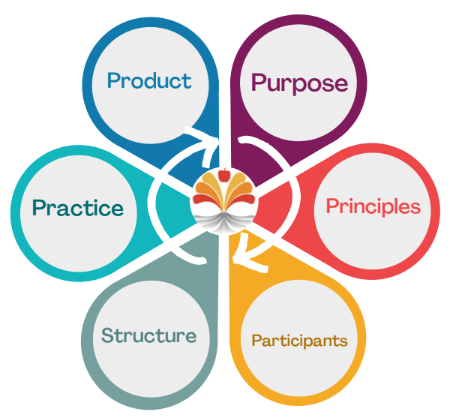
The SISEP micro-credentialing CoP is built around micro‑credentialing, or “a series of courses that culminate in a digital badge that lets employers and your professional network know that you have proficiency in a subject area” (Fredericks, 2026). Additionally, SISEP utilizes the liberating structure known as “purpose to practice” – or, in our case, “purpose to product” – within our CoPs. Within the CoP, we use the purpose to product process to define a common purpose, identify the principles that should guide participants’ work, determine the structures and supports needed for success, outline specific practices and next steps, and identify products that will result from the CoP. This approach ensures that conversations move beyond idea sharing toward actionable strategies that participants can implement within their own organizations or systems. We also reassure participants that it’s okay to be inexperienced, and that growth is part of the process. There’s space to talk honestly about both success and challenges. It is a learning environment, but it also creates an environment where people can grow, experiment, and improve together. Micro‑credentialing helps anchor these principles in real examples of practice, not just ideas.
Who participates?
Micro-credentialing is powered by practitioners doing the work every day in their own settings, applying what they learned to their work in the field, and a community of practice helps to amplify those voices. The target audience for SISEP’s micro-credentialing program is K-12 educators, including state, regional, and district staff; Institute of Higher Education faculty and students; and OSEP-funded TA Center staff. Participants are encouraged to share their experiences in the CoP through implementation stories, learning alongside others in cohorts, and engaging in level-based discussions that reflect their stage of implementation. Ultimately, participants contribute their knowledge to support others. It’s not about one voice leading the way; it’s about many voices shaping the work together. This creates a space where participants are not just learning; they’re building and sharing evidence of their growth.
How does it work?
This is not theoretical; it is not just a conversation. The work is hands-on, ongoing, and evolving. The CoP is intentionally structured to support the micro‑credentialing process. It is supported by structures, practices, and products.
Structures: Creating a shared learning space
Participants in the CoP have opportunities to share their work as part of their micro‑credentialing journey by sharing problems of practice and identifying potential strategies. By sharing implementation barriers in small groups, it allows participants to build confidence in communicating implementation efforts. Participants also ask challenging questions and refine their thinking throughout the process and are encouraged to share resources and give feedback. These structures create the foundation for a meaningful CoP and micro‑credentialing experience.
Practice: Where micro‑credentialing really comes to life
Participants build a portfolio of implementation “stories” or “journeys” as part of earning micro‑credentials. The first six badges, or levels, require participants to complete specific implementation activities and strategies associated with the Active Implementation Frameworks, while at the same time reflecting on their own core competencies as an implementation specialist. This allows participants to explore what it takes to sustain and expand initiatives over time and share their experiences in the CoP. Micro‑credentialing ensures that practice is documented, reflected, and continuously improved.
Products: Work that extends beyond the experience itself
Throughout the experience, participants create resources that define effective implementation for their organizations or agencies. Additionally, they learn to utilize tools that are available such as the Hexagon Tool, capacity assessments, and PDSA planning template. Micro‑credentialing helps turn these products into recognized, meaningful evidence of learning and impact.
What does it look like in practice?
One of the most powerful aspects of this work is seeing how participants grow through micro‑credentialing. Participants enter the program often with limited experience or knowledge of implementation science, and the CoP allows them to explore new concepts and begin connecting them to their work. As they progress through the program, the micro-credentialing activities provide opportunities to apply their learning while the CoPs provide a space to discuss their experiences, celebrations, and challenges. Towards the end of the journey, participants are then able to use their knowledge and network to scale their implementation efforts.
These aren’t just milestones; they represent real growth demonstrated through action and artifacts. Here is what participants share that they have learned:
- “Implementation science is moving away from hoping it happens to making it happen.”
- “Implementation science is the thoughtful process of working through a new initiative in order to ensure that the work is done systematically and with fidelity.”
- “Improve using what we know from science to implement evidence-based practices in real-world settings to outcomes.”
- “A set of principles and tools to get from vision to outcomes sustainably and systemically.”
Why combining a Community of Practice with micro‑credentialing is worth the investment.
Using a CoP with micro‑credentialing offers participants the opportunity to strengthen their skill set; it ensures that learning does not stay theoretical but becomes visible. Practices are intentionally discussed, documented growth can be shared and built upon, and implementation efforts are both meaningful and measurable. In short, it helps move the work from “we talked about it” to “we did it and here’s the evidence.” The micro‑credentialing CoP is a structured, collaborative experience where people move from purpose to practice to product while demonstrating their learning every step of the way. At the end of the day, it’s not just about what we know; it’s about what we do with it!
Resources
References
Fredericks, C. (2026, February 25). What is a microcredential? Here’s what you should know. Oregon State Ecampus. https://ecampus.oregonstate.edu/news/what-is-a-microcredential/#top
Wenger-Trayner, E. and Wenger-Trayner, B. (2015). An introduction to communities of practice: A brief overview of the concept and its uses. https://www.wenger-trayner.com/introduction-to-communities-of-practice/