
Home > Implementation for Educators Blog
Stop Chasing Programs and Start Investing in Implementation and Return on Investment

Why Implementation is the Return on Investment Conversation
Within the field of education, we are experiencing a period of budget uncertainty. ESSER funds provided to address challenges from COVID are gone, grant dollars we have traditionally depended on are shrinking or being eliminated, and budget allocations are being sliced at the state level. In a time when districts are asked to do more with less, how do you ensure your return on investment (ROI) for all of the efforts it takes to make improvements? The answer is simple: implement programs and practices better.
In the world of business, there is a theory called the Iron Triangle or Project Cost Model that has stood the test of time (Barnes, 2006). It is the concept that when you take on a new initiative, you need to examine the scope, cost, and time required to implement. We can apply the same theory to our educational implementation efforts. The image below illustrates the interplay among scope, cost, and time.
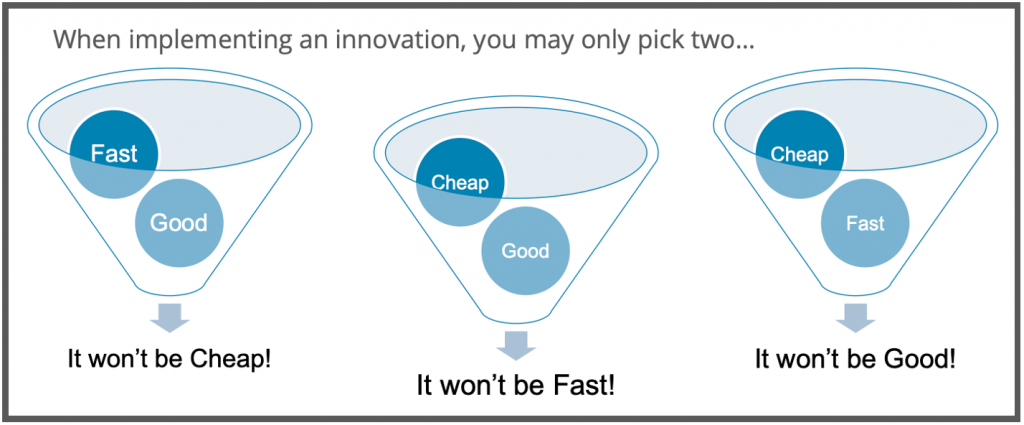
Let’s take a look at the three different scenarios. If an innovation is well developed and operationalized and you can implement it quickly, it will most likely not be cheap. While this would be the preferred approach, in times of financial constraints, this can be challenging for districts. The second scenario indicates that if something is inexpensive and a good program, you will not be able to implement it quickly, as there will be steps to build capacity that take time, so you will not see outcomes right away. Finally, in the third scenario, which is the most common, if something is inexpensive and you can implement it quickly, your outcomes will most likely be poor (Johnson, 2025).
Our best approach is the middle scenario, focusing on your implementation approach, which can help bridge the gap between investment and impact by addressing gaps and barriers in programs and practices, rather than throwing them out and starting over. Implementation forces us to examine and discuss what might be hindering progress, rather than simply blaming the program we just spent a significant amount of money on.
The Hidden Costs of Poor Implementation
When funding becomes unstable, it can be challenging to buy expensive High-Quality Instructional Materials (HQIMs) that come with all of the necessary supports, or to secure a technical assistance provider to support implementation and address program quality of the program. Additionally, we often expect that when we purchase HQIMs or spend time on training of evidence-based practices, we should see outcomes within a year. It is the false assumption that, “We bought a great program, why aren’t outcomes changing?” When this happens, districts often dump programs within one to three years of implementation, without considering how the implementation actually occurred. This ongoing cycle of purchasing new programs or HQIM only to start over hits your bottom line. You waste funds on the constant purchase of new materials and on increased staff burnout and turnover, which create inefficiencies that cost time and ultimately trust.
How Implementation Science Strengthens ROI
Let’s go back to our Iron Triangle. If funding is unstable, we need to focus on making what we have good and take the time to implement it effectively. In a study by Hill-Jackson et al. (2024), the authors identified several implementation mechanisms that positively impacted ROI on a teacher retention program, including strategic use of resources, quality of the programming, community support, and dedicated time and space. The authors also indicate a direct connection between the quality of implementation and ROI. While this area of study needs further research, at SISEP, we recommend the use of the Active Implementation Frameworks to address challenges in implementation and increase your ROI. Let’s take a look at where these connections exist. Below are the Active Implementation Frameworks and the connection to ROI for each framework.
- Usable Innovation
- Examine the level of quality of the program and identify the gaps you need to address, along with their cost. Discuss what you will need to invest in to ensure the program or practice is teachable, learnable, doable, and assessable.
- Stages of Implementation
- Planning (Exploration & Installation) before you jump into initial implementation can save you time, effort, and money.
- Implementation Drivers
- Competency drivers reduce performance variability.
- Organizational drivers create stability and reduce waste.
- Leadership addresses barriers so teams and teachers stay on track.
- Implementation Teams
- Guide decisions about needed resources versus wants. Teams can also examine data to identify specific supports, preventing time from being wasted.
- Improvement Cycles
- Continuous data-based adjustments prevent costly drift. The focus on improvement also prevents teams from deselecting or “dumping” a program too soon.
Shifting Your Focus for ROI and Next Steps
When looking at these connections, we also need to consider that ROI should not only be measured in the cost of programs, but also in the time and effort it takes to implement, including the necessary training, coaching, collaboration, and data-based decision making. Use your dollars and time to improve implementation and see the gains you want, and stop throwing them out the window with every program purchase. Shift your thinking from the traditional ROI calculation of (Net Profit/Net Costs) * 100% and think of it more like:
Implementation ROI = (Outcomes + Capacity Gains) / Effort & Resources Used
Think about how you can start to identify the cost of poor implementation in your district or school. You can start this conversation by first looking at your spending-versus-outcome data. What are the correlations? Are you happy with the results? Where are you spending the majority of your dollars, and is it paying off? While many districts have software that allows you to track expenditures, one place you could start your journey is the Edunomics Lab at Georgetown University. The ROI scatterplots allow you to drill down to your district and schools to take a look at resource allocation and discuss how you are leveraging funds in correlation with student outcomes. Another step you can take is to complete or reexamine your initiative inventory with ROI in mind. District and school teams often skip the more challenging questions on how an initiative or innovation is funded and what the outcomes are. Take the time to dig in and do some fact-finding. You might be surprised by what you find.
Implementation is the Investment
As you begin to examine data and budgets for next year, consider investing in structures, relationships, and routines that support implementation, versus buying the next new program or the hottest new gadgets. Have the hard conversations about what your data is telling you about implementation and what needs to happen to make improvements. Remember, if you want results, fund the work that makes them possible.
References
Barnes, M. (2006). How it all began. PM World Today, PM World Library. https://pmworldlibrary.net/wp-content/uploads/2018/11/pmwl-barnes-how-it-all-began-pmwt-july-2006.pdf
Hill-Jackson, V., Loyde, D., Caldwell, C., Waight, J., & Perry, S. (2024). A teacher residency program at the “Crossroads of Texas”: A case study examining return on investment. Theory & Practice in Rural Education, 14(2), 123–153. https://doi.org/10.3776/tpre.2024.v14n2p123-153
Johnson, J. (2025, July 10). Fast, good or cheap — The iron triangle. Business.com. https://www.business.com/articles/fast-good-cheap-pick-three