
Home > Implementation for Educators Blog
Going Beyond a DSDS: Applying Organization Drivers for Systems Change

Implementation doesn’t happen by chance; it is supported by various drivers that make implementation success happen. NIRN’s Active Implementation Frameworks define various organization drivers, which are processes that can help foster a supportive environment for implementation within education settings. These drivers include systems for effectively leveraging data, policy alignment, and coordinating support across organizations. Organization drivers can influence/promote competency drivers, like training, coaching, and administrative support, to ensure educators can effectively use evidence-based practices.
Implementation teams often collect a lot of data and learn about the importance of using this data to guide quality improvement efforts. These data collection efforts that many implementation teams prioritize can be used to create a Decision Support Data System (DSDS), which is designed to help organizations or teams identify, collect, and analyze data that informs decision-making. When used well, a DSDS can do much more than simply store information. It can help teams turn data into actionable insights that guide implementation and quality improvement. Drivers like the DSDS are also needed to promote the development of competency drivers, such as training and coaching, by providing data to help implementation teams identify where these additional supports are most needed.
However, collecting and organizing data alone is rarely enough to support meaningful systems change. To fully support implementation, DSDS processes must be embedded within a broader set of organization drivers that help teams understand and respond to the realities of their implementation context.
What Is a Decision Support Data System? A Deeper Dive
A DSDS supports improvement by helping implementation teams gather and organize different types of information that inform decision-making. This often includes using multiple forms of data that together help teams understand both how implementation is occurring and whether it is producing the intended outcomes.
For example, teams may collect:
- Fidelity data to capture whether a program or practice is being delivered as intended
- Outcome data to determine if the intervention is producing its desired results
- Process data to help teams understand how implementation activities are unfolding
- Improvement data to support ongoing learning and modification
Together, these data sources allow teams to monitor implementation and identify areas where adjustments may be needed. Within the Active Implementation Frameworks, DSDS processes are designed to support continuous improvement cycles, such as Plan–Do–Study–Act (PDSA) cycles. In these cycles, teams identify a problem, test a strategy, study the results, and refine their approach based on what they learn (National Implementation Research Network [NIRN], n.d.). In practice, DSDS tools can be used by teams to guide structured problem-solving and action planning in schools and districts.
However, even the most well-designed data system cannot fully explain why implementation succeeds in some settings and struggles in others.
Implementation Happens in Context
Implementation does not occur in a vacuum! Schools, districts, and other organizations operate in complex environments where leadership structures, district priorities, and available resources within schools can influence how evidence-based practices are adopted and used.
Research highlights the importance of organization context, which includes factors like leadership, implementation climate, resources, and staff collaboration, among many others. Previous research has emphasized the importance of implementation context on practice use and adoption in schools, noting that supportive leadership (e.g., endorsing the implementation effort) and staff team structure (e.g., information sharing, collaboration) played a significant role in how well an evidence-based practice was used (Locke et al., 2019).
While a DSDS helps organizations collect and interpret data, it is important to recognize that factors, like context, help determine how effectively organizations can respond to what the data reveal.
Using Data to Activate Organization Drivers
Organization drivers, including DSDS, provide the infrastructure that allows implementation teams to act on the insights generated. These drivers help to develop administrative systems, decision-making processes, and leadership supports that help foster a context where implementation can succeed. When implementation teams have clear DSDS processes, implementation teams can move beyond simply monitoring progress toward actively improving their systems.
For example, DSDS data might reveal that educators are struggling to maintain fidelity to a particular intervention component. That information identifies a challenge being encountered, but it does not explain why the challenge is occurring. Organization drivers help teams examine underlying system factors, such as whether educators have access to sufficient training or administrative support, which are key competency drivers. In this way, organization drivers like DSDS support the effective use of competency drivers (coaching, training, administrative support) by ensuring these activities are aligned with the needs identified by the data generated.
Identifying and addressing these types of challenges is critical for successful implementation efforts. Previous research emphasizes that to have successful organization change, leveraging specific “change drivers” once barriers are identified is critical to moving initiatives forward (Akins et al., 2019). Organization change processes are often iterative, requiring ongoing assessment of barriers and adjustment of strategies as conditions evolve.
Similarly, implementation teams can use DSDS data to identify challenges and then rely on organization drivers to design targeted responses, such as adjusting policies, strengthening leadership supports, or providing additional implementation supports.
Drivers Work Together
NIRN’s Active Implementation Frameworks emphasize that drivers are both compensatory and can work together synergistically.
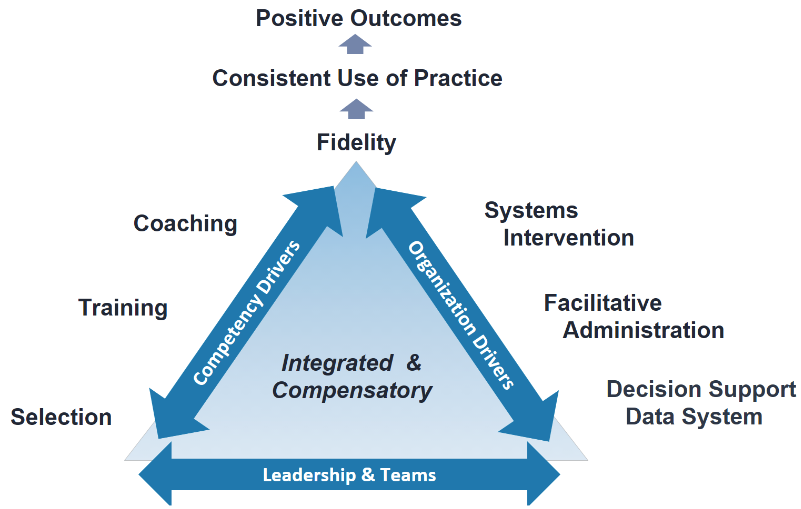
Leadership and teams serve as the foundation for effective implementation, while organization and competency drivers work together to support implementation and practice use. Data systems like a DSDS can be the bridging mechanism across the various drivers by providing shared information that can inform solutions to challenges. Leveraging data obtained through a DSDS can also help teams identify compensatory mechanisms. Strengths in one area/domain can sometimes help offset challenges in another. For example, strong leadership engagement or effective collaboration among staff may help organizations navigate resource constraints. All three of these are important contextual factors, but strengths in one area can help “make up for” weaknesses in another area. Over time, when these drivers work together and are informed by ongoing data use, they can compound to strengthen an organization’s overall implementation capacity.
From Data Systems to Systems Change
Ultimately, the purpose of a DSDS is not simply to collect more data, it is to create usable information that supports learning, adaptation, and improvement.
When data systems like a DSDS are connected explicitly to other organization drivers, implementation teams are better positioned to not just identify barriers but also test solutions and employ implementation strategies through continuous quality improvement (CQI). This iterative process reflects broader insights from organization change research, which suggests that meaningful change often emerges through repeated cycles of identifying barriers, activating change drivers, and adapting strategies over time (Akins et al., 2019).
By establishing a strong DSDS process and infrastructure, implementation teams can move beyond data collection and strengthen the infrastructure that supports effective practices across classrooms, schools, and districts.
In this way, a DSDS becomes more than a technical tool. It becomes part of a broader implementation system that helps organizations learn from their data and continuously improve how they support practitioners and the communities they serve.
References
E. Akins, E., II, Giddens, E., Glassmeyer, D., Gruss, A., Kalamas Hedden, M., Slinger-Friedman, V., & Weand, M. (2019). Sustainability education and organizational change: A critical case study of barriers and change drivers at a higher education institution. Sustainability, 11(2), 501. https://doi.org/10.3390/su11020501
Locke, J., Lee, K., Cook, C. R., Frederick, L., Vázquez-Colón, C., Ehrhart, M. G., Aarons, G. A., Davis, C., & Lyon, A. R. (2019). Understanding the organizational implementation context of schools: A qualitative study of school district administrators, principals, and teachers. School Mental Health, 11(3), 379–399. https://doi.org/10.1007/s12310-018-9292-1
National Implementation Research Network (n.d.). Decision Support Data Systems: Examples from Practice. https://implementation.fpg.unc.edu/resource/decision-support-data-systems-examples-from-practice/